
The Diagnostic Journey: Why Rare Diseases Still Take Years to Identify
For many families, the path to a rare disease diagnosis is not defined by a single moment, but by a series of observations, questions, and evaluations that unfold over time. It often begins with subtle changes—differences in development, movement, or behavior that do not follow an expected pattern. At first, these signs may be attributed to more common conditions. As concerns persist, families begin seeking additional opinions and testing.
Across the rare disease community, the time to diagnosis can be prolonged. On average, individuals may wait four to six years before receiving an accurate diagnosis, often consulting multiple specialists along the way. It is also not uncommon for patients to receive more than one diagnosis before the underlying condition is identified, particularly when symptoms overlap with more familiar disorders.
Part of this complexity reflects the nature of rare diseases themselves. While each condition is uncommon, collectively they affect more than 300 million people worldwide and encompass thousands of distinct disorders. Most clinicians will encounter only a small number of these conditions in practice, which can make early recognition challenging.
An explanatory video made by Rare Disease International.
In conditions such as H-ABC/TUBB4A related leukodystrophy, the diagnostic process can be especially nuanced. Early symptoms may resemble other neurological or developmental conditions, and imaging findings may suggest abnormalities without pointing to a specific cause. In many cases, a definitive diagnosis depends on genetic testing.
A substantial proportion of rare diseases—estimated at 70 to 80 percent—have a genetic basis. For H-ABC/TUBB4A, confirmation requires identifying a mutation in the TUBB4A gene. However, referral for genetic evaluation may not occur immediately, particularly when earlier assessments are inconclusive.
Delays in diagnosis can have practical implications. Without a clear diagnosis, families may have difficulty accessing condition-specific care, therapy services, or educational support. It may also limit awareness of research opportunities or registries that depend on confirmed diagnoses. The process itself can involve repeated testing, travel to specialty centers, and ongoing coordination of care.
At the same time, advances in genomic medicine are beginning to change this landscape. Tools such as whole exome and whole genome sequencing are increasingly being used earlier in the diagnostic process, helping to identify underlying conditions more efficiently in some cases.
Timely diagnosis is particularly relevant in pediatric-onset conditions, where early understanding of the condition can help guide care decisions, support developmental planning, and connect families with appropriate resources.
For individuals and families affected by H-ABC/TUBB4A, continued efforts to improve awareness, expand access to genetic testing, and support earlier referral pathways remain important. Over time, these changes may help shorten the diagnostic process and provide families with clearer direction at an earlier stage.
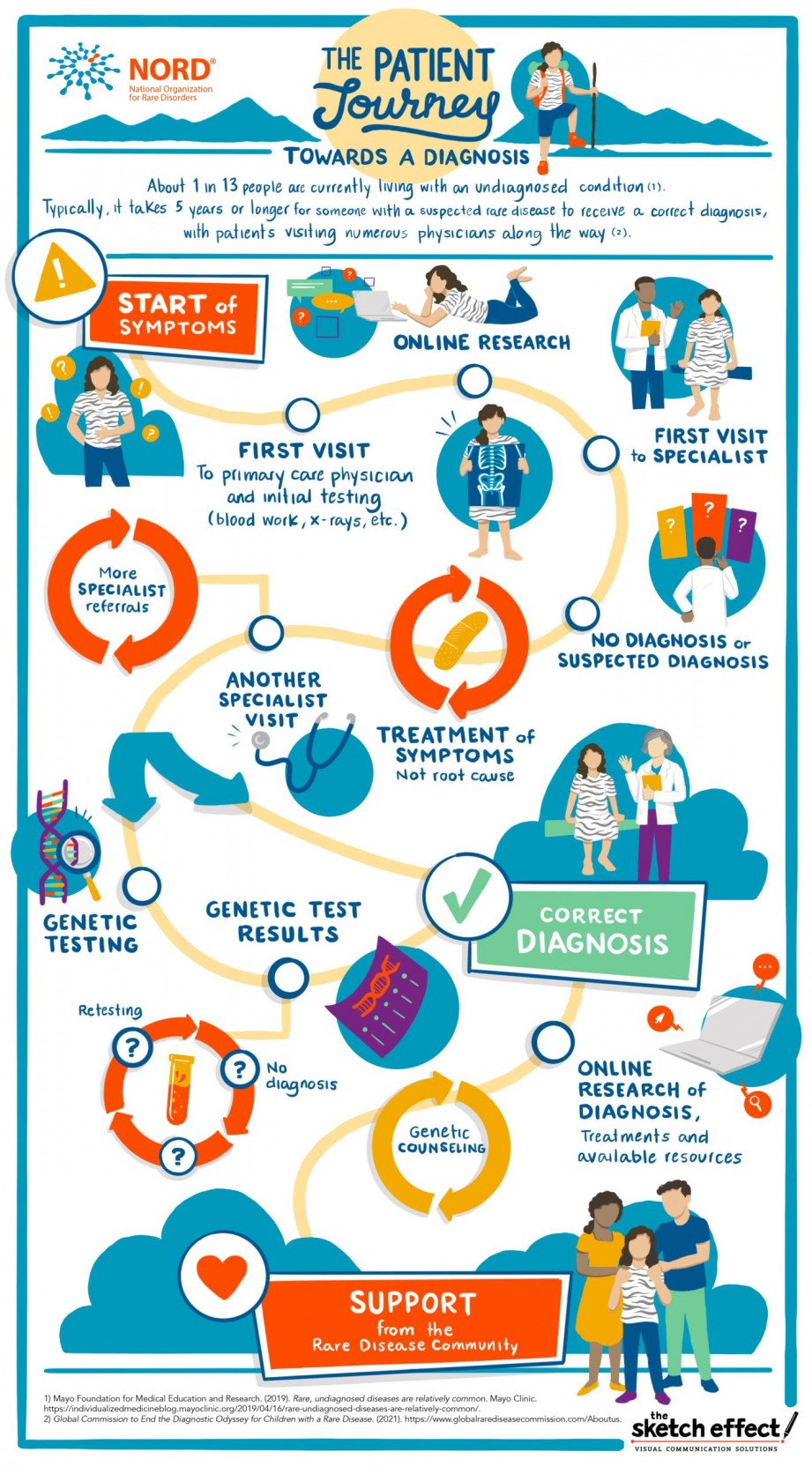
A Patient Journey Infographic - by the National Organisation for Rare Diseases (NORD, USA)
Sources & Further Reading